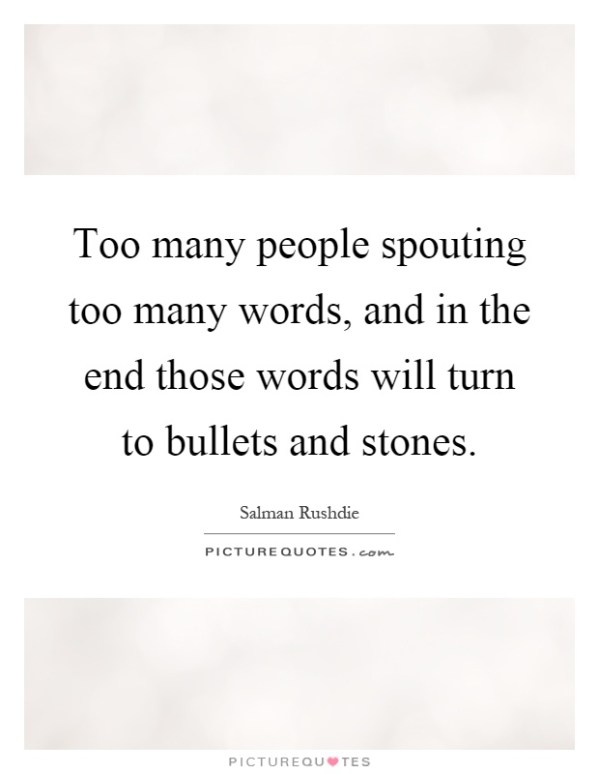
“You Use Too Many Words”

I have a friend with whom I rarely speak, but whom I value and respect very much. Perhaps that is why I listen a bit more intently when he shares something, or why his words to me penetrate more deeply than those I hear elsewhere.  Six  years ago he told me something that penetrated to a most vulnerable and defensive spot in me,  “You use too many words.”

I’ve been running from the possibility of being truly still with the things that really move and affect me since I was a teenager. In fact, personal journaling and letter writing have often seemed a compulsive madness to me. Somewhere in the mess of words were the few that were my real, and most sincere, intentional expressions. But how to know?  Since that moment in 2008, when I read those simple five words from my friend, “You use too many words,”  I’ve been working to open that closed place in me that needed all those words.

Throughout my years as a university professor, I recall the many evenings after graduate seminars, when I felt dirty from all the words I’d been spewing.  More often than not, it was not because I had said something I didn’t mean or believe, or because I’d lied or been cruel, but because I had not been strong enough to allow myself to be silent. But when confronted by the observation of my verbose tendencies, my response was lacking in integrity–I acknowledged and identified with my ‘belief’ in silence, my ‘belief’ in mindful expression.  I defended the morass of words I’d expressed, as if they had been mindfully voiced.  Such efforts felt ugly and were beyond using “too many words;” they were dishonest.

Yes, words are powerful, and, yes, words can help me say a lot of things that perhaps I may even have meant to express.  But silence, and prayer, and contemplation–these are the expressions of my heart and soul that allow me to open up in humility to the Source that is greater than anything I might think I need to say. And this is the conviction I hold that places me in a heretical stance to a profession that I must mindfully patrol. I must watch with care that my ego and personality weaknesses not be tempted by an assumed “right” that I have somehow earned to “use too many words.”

The most powerful things I have written have all been “written through me,” not by me. If I am not living a life that helps me to practice the ability to be still and silent, there is no room or time or place for this to occur.  My words then become mirrors of my world, or worse, compulsive repetition of mental tropes, professional scripts, cultural norms.

Perhaps one of the greatest heresies to which I am called is the mindful defiance of the norms of my profession–the norm of believing that we must “publish or perish.” Because truthfully, I feel myself perishing, not because I am not minding the publishing clock, but each time I use words in a perfunctory, “busy,” institutionalized style,  or more vulnerably, out of fear or egotistical strategy.  I do not need to publish, or even speak or write to be of value, or to live fully. But I do need silence, and out of that silence, come words through me.

My grandfather told me, when I was three years old, that I could write as much as I wanted to, as long as I had something to say.  But to write without saying something, was wasting paper, he told me.*

May I be mindful of my words, and strong enough in my faith and connection to my purpose in this life, to know I need not be bound by the conventions and orthodoxies of expression surrounding me. And may I not contribute to these conventions through my ego’s folly, my spiritual sloth, or my mindless jabber.

*“In Search of the Voice I Always Had” 

It’s Damned Hard to Live a Quiet Life, and Other Thoughts

I have been thinking about the philosophy of nonviolence very much lately. The 50th Anniversary of the 1963 March in Washington, D.C., and MLK, Jr.’s “I Have a Dream” speech, the potential to attack Syria “justifiably,” and the continuous streams of hatred spewing from the mouths of political leaders and espoused journalists are powerful prompts to reflection for me right now. But truly, the prompts are around us every single day on our everyday streets and in our homes, not only here in Arizona, or in my native state and lands of my family and ancestors, Texas and Mexico, or on university campuses and at academic conferences, on the terrain of critical post-colonial, feminist, sustainable, globalized, gender-sensitive, humanistic scholarship…yes, the prompts are ever-present in the world around me.

I believe in nonviolence, studied it with individuals far more worthy of its mantle than I am, and find it the hardest practice in my life. If I work to be true to Gandhi’s teachings of avoiding even the violence in my heart, in my thoughts and beliefs, I am repeatedly humbled. My frequent slips of mind and voice and action which are so readily woven into not only my personality but the norms and attitudes around me, can not be secret or sources of my shame, however. To silence the difficulty of the practice increases the oversimplification of nonviolence into a litany of platitudes and hypocritical smiles and hugs.

If the capacity to refrain from projection and displacement of our foibles and hidden vices and sins were somehow natural for human beings, so much of the ugliness of our social history worldwide would be absolutely different. And the scholarship on postcolonialism and racism might be a better representation of experience and victory than verbose attempts to vindicate one’s voice from privilege and/or association with damned practices.

There are always innocent individuals killed when vindicated ‘strikes’ are made. I am very glad that the president’s expressed belief in the ‘rightful’ need to strike Syria somehow is being taken to the Congress, where the recalcitrance of our legislators to support anything Obama says, does or even looks at…may result in not taking action of this sort. But the simple act of not doing so does not remove the violence in the hearts of so many among whom we live and who call themselves and have even been elected to be called our leaders. Envy, resentment, conscious avoidance, class-stratifying policies and availability of basic needs, as well as supporting ‘good social policy’ for ‘those people’, and political correctness for the sake of one’s privilege–all these are violence in the heart.

All around us we divert and amuse ourselves with the evidence that we are remarkably creative and capable of doing and saying so many things that bring pleasure and joy to each other and ourselves. If we could use our intelligence and creative impulses to speak, act, spend, and interact in ways that bring us together without distinctions of Otherness that privilege or harm…I imagine how different things could be. And so I will keep on keeping on , ‘marching’ not to the sound of my own drummer, but to a beat that I believe is there for all of us to hear. It’s just so noisy with all these things we fill our lives with, and it’s damned hard to choose to live a more quiet life.

the birthing

suddenly you find the world becomes you
and every living moment becomes
like the wind
something you can’t see coming
or going
but things have changed
and it will never be the same
you can never again
control your words
and feel true

Sarah Amira de la Garza, August 16, 2011

Blog at WordPress.com.

Up ↑